
Course

Śrī Bhagavad Gītā

श्रीमद्भगवद्गीता

The Gītā taken chapter by chapter — each verse heard, placed syllable by syllable, then brought to its metre, with the meaning explained before it is recited.

Enrolment open Live online class Learners of fifteen and above, reciting the Gītā for the first time or correcting one they already have
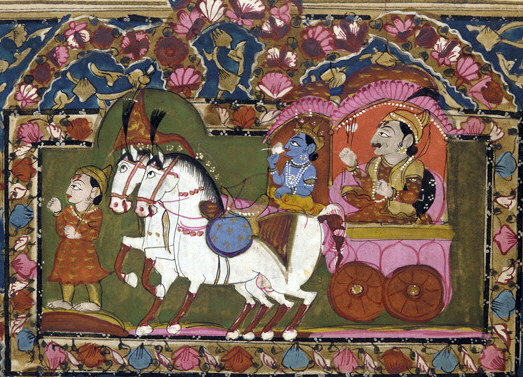
An Indian miniature painting of Krishna driving Arjuna’s chariot, from a Mahabharata manuscript
श्रीमद्भगवद्गीता

Course Overview

A course of its own, rather than a text taught within another group. Seven hundred verses across eighteen chapters is a great deal to hold, so the Gītā is taken a chapter at a time and no chapter is left behind for the sake of pace.

The Anuṣṭubh metre most of the Gītā is written in is steady and forgiving, which makes it a good text to learn recitation on. The longer metres that close several chapters are worked at separately, since they ask for different breath.

Learners who want only a part of it are welcome to take only that part. Chapter 12 and Chapter 15 are both commonly recited on their own, and either can be studied as a short course.

Texts Taught in This Course

A course is built around what you would like to take up. Nobody works through all of these, and they are listed shortest first so there is somewhere comfortable to begin.

  • Invocation

    Gītā Dhyānam

    The nine invocatory verses recited before the Gītā itself. Usually where the course begins — short, and a settled place to get the pronunciation right before the chapters start.

  • Chapter

    Chapter 12 — Bhakti Yoga

    Twenty verses, widely recited on its own as a daily practice. Often taken as a short course by learners who would rather have one chapter well than eighteen approximately.

  • Chapter

    Chapter 15 — Puruṣottama Yoga

    Twenty verses, recited in many households before a meal. Short enough to learn in a few sessions and to keep up afterwards.

  • Chapters

    Chapters 1–6

    From Arjuna’s despondency through to meditation. Almost entirely in the Anuṣṭubh metre, which makes this the steadiest stretch to learn on.

  • Chapters

    Chapters 7–12

    The central chapters, closing with Bhakti Yoga. Chapter 11 carries several of the longer metres and is worked at slowly.

  • Chapters

    Chapters 13–18

    The closing chapters, ending with the long eighteenth. Taken once the metre and the breath are reliable.

What You Will Learn

  • Recite the Anuṣṭubh metre evenly, without hurrying the second half of a line
  • Articulate the conjunct consonants the Gītā is dense with
  • Manage breath across a full verse, and across the longer closing metres
  • Follow a chapter as a continuous argument rather than as separate verses
  • Understand the plain sense of what is being recited, verse by verse
  • Hold a chapter in regular practice once the course has finished

Who Can Join

  • Learners of fifteen and above, beginning a structured recitation of the Gītā
  • Learners who recite the Gītā already and want the pronunciation corrected
  • Households that read a chapter together and would like it read accurately
  • Anyone wanting Chapter 12 or Chapter 15 on its own

How It Is Taught

  1. 1 Listen first. Each line is heard clearly before it is attempted, so the ear learns the sound before the tongue shapes it.
  2. 2 Pronunciation is broken down syllable by syllable, with attention to the placement of each sound.
  3. 3 Rhythm and breath are practised slowly, then brought to their natural pace.
  4. 4 Meaning is explained in simple language so the words are understood, not only repeated.
  5. 5 Individual corrections are given during class, gently and specifically.
  6. 6 Recitation is brought together with awareness and devotion.

Structure of a Class

01 Opening prayer and a settling of attention
02 Revision of the previous session, with corrections
03 New lines: listening, syllable work and slow repetition
04 Explanation of meaning and context
05 Rhythmic recitation together
06 Practice guidance for the week ahead

Questions People Ask

No. The Gītā is taught by ear and by syllable, and the meaning of each verse is explained in simple language before it is recited. Learners who already recite are helped to correct pronunciation and steady the metre.

No. The course is arranged around what a learner or batch would like to take up. Some work through the whole text over a long period; many come for a single chapter — Chapter 12 and Chapter 15 are the two most often asked for.

The focus is recitation — pronunciation, metre, breath and phrasing. The plain meaning of each verse is explained so the words are understood rather than only sounded, but this is not a commentary class and no single school of interpretation is taught.

Both. Small groups and individual classes are available. Groups are kept small enough that every learner is still heard and corrected personally.

Classes are conducted live online so that pronunciation can be corrected personally. Practice material is shared to support regular revision between sessions.

Timings and fees are shared directly on enquiry, as they depend on the batch, the learner group and time zones. Please use the enquiry form and you will receive the current details.

Enquire

Ask About Śrī Bhagavad Gītā

Send a note about your experience so far and what you would like to learn, and you will receive current timings and details.

Preferred way to be contacted

Fields marked * are required.